![[[ Mess | Order ]]](https://substackcdn.com/image/fetch/$s_!DT-K!,w_120,h_120,c_fill,f_webp,q_auto:good,fl_progressive:steep/https%3A%2F%2Fsubstack-post-media.s3.amazonaws.com%2Fpublic%2Fimages%2Fdd6e649f-6751-4252-ac26-b62ab22b1b6c_500x500.png)
![[[ Mess | Order ]]](https://substackcdn.com/image/fetch/$s_!TULC!,e_trim:10:white/e_trim:10:transparent/h_72,c_limit,f_auto,q_auto:good,fl_progressive:steep/https%3A%2F%2Fsubstack-post-media.s3.amazonaws.com%2Fpublic%2Fimages%2Fd0bf8d2f-4256-4022-8c55-0c2760b9ee5a_1344x256.png)
PKMS Is the Cardiovascular System of Ideas
Your brain makes ideas, your PKMS circulates them

PKMS Is the Cardiovascular System of Ideas
The cardiovascular system (CVS) is at the core of how the human body functions.
Why do muscles grow? Because the CVS delivers nutrients to them.
How does the body heal? The CVS transports antibodies to the right place.
How does water become urine? It enters the bloodstream, flows to the kidneys, then to the bladder.
The CVS is made of three components: the heart, the blood, and the blood vessels.
They operate in balance to keep every part of the body alive and functioning.
That’s why cardiovascular diseases are the leading cause of death: even a minor issue can cascade into a system failure.
The same logic applies to personal knowledge management systems (PKMS).
Some people define their PKMS as a method (like Zettelkasten), some focus on software, others walk you through their 40 physical notebooks.
That’s all fine, but it misses the systemic view.
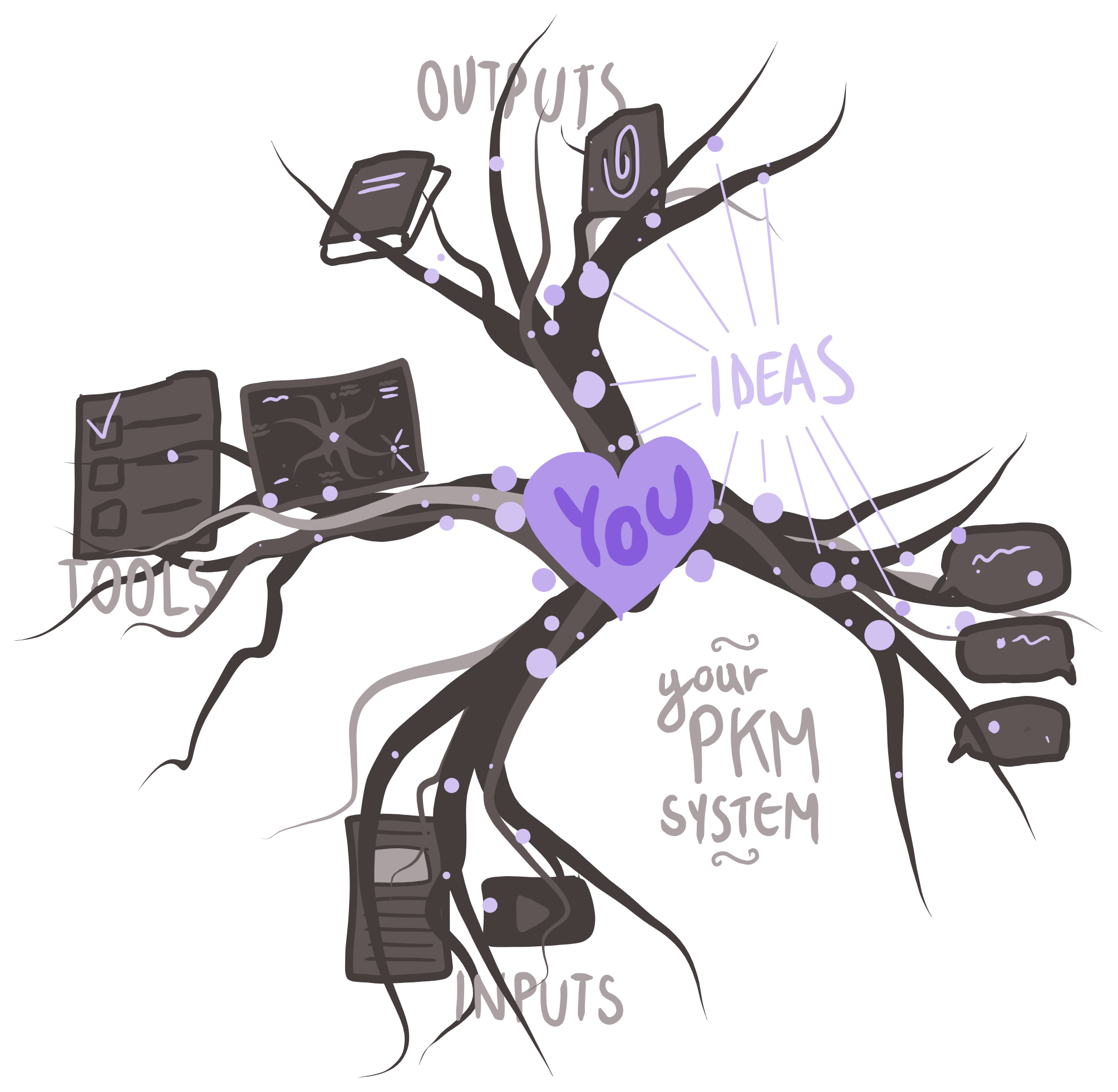
PKMS is the cardiovascular system of your ideas.
You are the heart
Ideas are the blood
Systems and workflows are the blood vessels
Tools are the organs
Each tool, like each organ, plays a distinct role: task managers handle actions, note-taking tools shape thinking, collaboration tools connect people.
Just like the body, if one part malfunctions, the entire system starts to break down.
There’s No Such Thing as the Perfect PKMS
There’s no such thing as a perfect cardiovascular system.
There are countless congenital defects, and even natural anatomical variations like a right-dominant coronary circulation (which I’ve seen firsthand!).
And when something goes wrong, like a blockage, the body adapts: it builds alternate pathways, known as collateral circulation.
Same goes for PKMS.
Everyone starts with different tools at different times.
Thanks to a friend’s recommendation, I began with Obsidian back when it first launched.
Over time, the "circulation" of ideas took shape and the organ of thought (not my brain, Obsidian!) grew.
I still have inconsistencies in properties like "math" and "mathematics" because there was no autocompletion back then!
Then my thinking evolved, and my PKM had to evolve too.
At first, Obsidian was my all-in-one tool.
Eventually, I felt the system getting clogged.
So I introduced other tools (Notion, Todoist, Tasks, ...) and kept experimenting, I built new pathways for my ideas.
Today, I still iterate: I explore new tools and archive options for the day my system needs to adapt again.
Understand How You Function
Your PKM system, like your cardiovascular system, exists in balance.
You shape it.
Your tools shape it.
Your method of capturing ideas shapes it.
And the opposite holds, as Nick Milo says:
Don’t aim for a perfect system.
Build one that can evolve because tomorrow you’ll be a different person.
And make it evolve!
Breathe new ideas into the system, keep it alive by pulsating changes into it!
And remember: the system is fragile.
If you don’t understand how you function, your PKMS will fail.
Thinking is inevitable, it's worth mastering it